Tuesday, August 12, 2014

2014 Long Stemmed Lavender Varieties Ready to Harvest (Instructions on Drying Lavender Included)

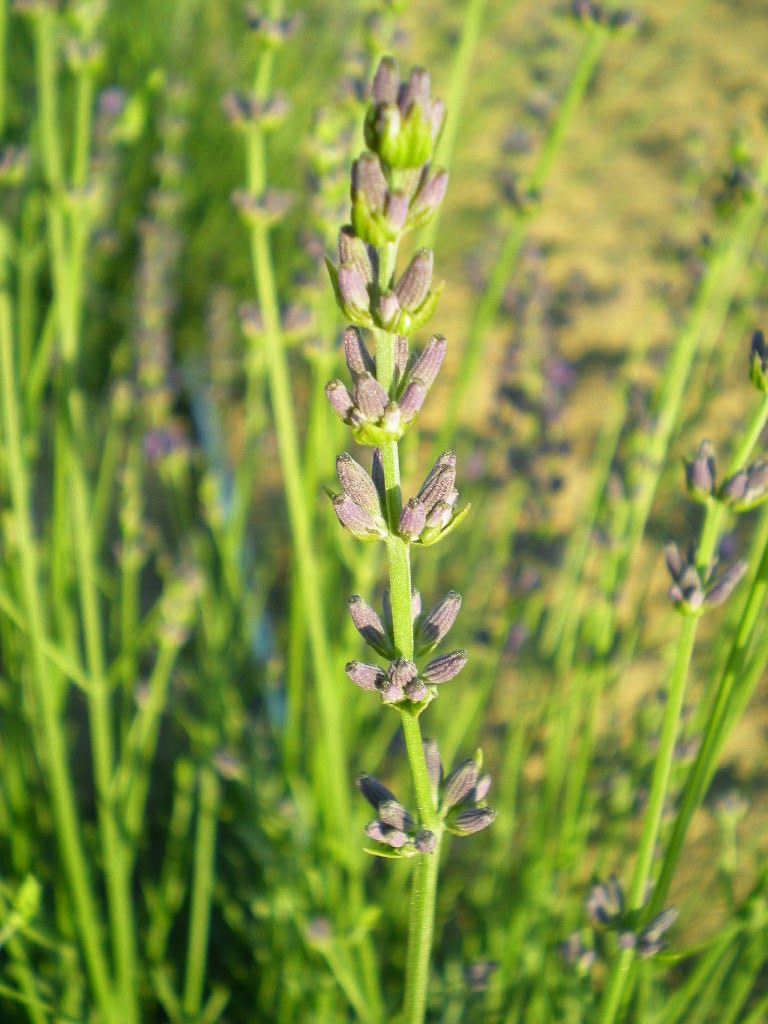
Lavendula x intermedia 'Grosso'.
The principle of drying flowers is to 
remove the moisture from them while 
retaining their original shape and color.

Five long-stemmed lavender varieties, Lavendula x intermedia 'Grosso', 'Gros Bleu', 'Edelweiss', 'Impress Purple', and 'Super' are ready to be harvested.  U-pick is $5/bundle; I-pick is $8/bundle (a bundle is 125 stems).   We also are offering an English lavender, Lavendula angustifolia' Purple Bouquet.  This lavender is beautiful in wreaths.  All six of these lavenders hang dry well. 

Still Waters Lavender is open Wednesday-Saturday, 10a-6p. 

Please provide your own cutting utensil.
"Flowers of lavender quilted in a cap, comfort the brain very well."
-William Turner, written in 1551-


Lavendula x intermedia 'Gros Blue".
Good air circulation will ensure that your flowers dry as quickly as possible, 
which will result in better color preservation and cut down on the possible growth of mold.   

Lavendula x intermedia 'Edelweiss'.
Cut the full length of the stem.
Strip all leaves from stems.
Lavendula x intermedia 'Impress Purple'
 Gather lavender into small bunches,
fasten each bunch at the end with a rubber band
.

Lavendula x intermedia 'Super'.
Hang the bunches so that air can pass between them.
Lavendula angustifolia 'Purple Bouquet'.
Hang the bunches away from direct light.


 L.ang 'Purple Bouquet''.
If there is too much light, cover each bunch with a paper bag,
tying the open top of the bag around the stems with string.
It takes approximately two weeks for lavender to dry.

"Nothing is ever wasted if it makes a happy memory."

Monday, August 11, 2014

... The Weapons of a Farmer are Mighty...


Did you know that one knapweed plant can produce up to 25,000 seeds per year?  I read that little tidbit in a pamphlet I picked up at the Deschutes County Fair this year.  Along with knapweed, we have some other nasty noxious invaders that are a scourge to us as well as to our animals.  Internet searching, reading everything we can get our hands on, talking to various agencies and scratching our heads for answers on how to get rid of the weeds is a constant war for my husband and I and we plan on winning.  Not only do weeds threaten our plants economically, they threaten our land ecologically.  Also, weeding  is time consuming and we needed a victory yesterday.

Earlier this spring my husband and I saw a YouTube video of a weeder, found on a FaceBook Page devoted to lavender farmers.  He called the lavender farmer in Washington State who had one of these machines and then called the company who made the machine.  The company, located in Quebec, Canada, answered speaking French...oops!  Thank heaven the fellow on the other end could speak and understand American English.  He told my husband of a distributor in the USA--Oregon, to be exact, and the third call my husband made was to the Oregon company.  They had one left; we said "sold" and the next day were on our way to Woodburn, saw it, asked questions (one important question for us was whether it could be used with drip irrigation), and, in about a week, it was home.  
daughter driving/husband's "dry run" on weeder

it's working?  it's working--whew!  It is working!


Easy to attach/easy to use

Good visibility  for seeing drip irrigation


.....SO FAR, SO GOOD....  One more weapon in our arsenal to defeat this enemy!

Monday, August 4, 2014

We No Longer Have Crafting Lavender for Sale


We currently have six varieties of English Lavender (Lavendula angustifolia) ready for harvest: 'True Hidcote', 'Melissa', 'Sachet', 'French Fields', 'Croxton's Wild' and 'Peter Pan'. English lavender has a sweet fragrance and  these six varieties were planted especially for crafters. Each variety (cultivar) has a unique aroma and we invite you to come and walk the field and experience the different sweet fragrances for yourself. Note that these six varieties were planted in 2013, came through -32 degrees weather this last winter along with the 90 degree weather we're having now and they still have two more years of growth before being considered mature plants.  Still Waters Lavender is located at 3990 NE 33rd Street; Redmond, Oregon 97756. We are open Wednesday-Saturday, 10a-6p. Price for one (1) bunch: U-pick is $5; I-pick is $8. (A bunch is considered 125 stems). Please bring your own cutting utensil.   


'True Hidcote', med. purple
'True Hidcote', popular in lavender lemonade

'Melissa', pink flowers (buds are white)


Melissa is also used in culinary; adds a "peppery" flavor.

'Sachet', lt. purple

'Sachet', prized for its sweet fragrance used in filling of pillows


'French Fields', med. purple
'French Fields', so named because of its resemblance to the lavender fields in France

'Croxton's Wild', buds are white; flowers are purple

'Croxton's Wild', beautiful plant; please do not feel obligated to do anything with them.

'Peter Pan', med. purple

'Peter Pan', compact; good for patio

Thank you for visiting our website.  We hope to see you soon.

Sunday, August 3, 2014

Welcome Friends, and Stay Awhile... Rest Your Weary Feet


Welcome friends, and stay awhile
Rest your weary feet;
Gaze upon the purple hues
And breathe the fragrance sweet.
We hope to make you welcome, friend
and want the best for you;
Faith, hope, charity,
Still waters and green pastures, too.


STILL WATERS LAVENDER

thanks all the visitors

to its

Very First

One of a Kind, Uniquely Relaxing

Grand Opening Festival held on 

July 12-13, 2014


Thursday, July 17, 2014

Who is In Control? Not Me!

 Mother Nature is such a whimsical dame.  Little did we know that she had a lavender farmer's worse nightmare up her sleeves which was about to whistle down from her armpits, guided through her hands and directed to cover  the land, affecting everyone who came into contact with her.  She was showing mere humanity that she was nothing to be trifled with!

This winter started mild for Central Oregon.  We enjoyed the crispness in the air and the cold nights.  The lavender seemed fine, nothing the Test Block and Block A hadn't experienced in the past.  Even the young plants planted in Blocks C and D that year were withstanding our weather change.  One thing was different, though, and that was the wind.  We have wind but this year it was stronger.  It hurt the ears and dried up the nose, making it difficult to breathe.  We woke up to the beautiful "sush" of falling snow one morning.  That was o.k.  It covered the plants and put a "hush" over the land that calms the soul.  Then more snow fell.  That was o.k., too.  Cross country skiing, for me, requires at least six inches of snow to cover the gravel roads around the area and onto BLM (Bureau of Land Management) land where I could go to Idaho (and beyond) should I choose.  Then, after a few days, the snow melted off the plants, but the wind kept blowing and the temperature started plummeting.  For several weeks, we watched in horror as the uncovered plants endured minus temperatures.  Then came the -32 degree nights.  A sickening feeling hit my husband and I in the pits of our stomachs:  this definitely was not good!  There was nothing we could do but sit and watch and wonder whether we would have any lavender left after this winter punch.

Come spring, we read the reports from back East and the Midwest.  Our hearts cried for those who had endured so many freezing storms and lost most, if not all, of their lavender.  Then came the reports of tornadoes which destroyed homes and barns in the Midwest.  My husband and I felt like "little mouth frogs"...we did not have any right to complain after hearing of the devastation some of these families experienced.  We kept saying to each other, "Wait until June 15; wait until then to see if there's any life in the lavender."  And, lo and behold, life was there, close to the Earth and under the dead stems.  We would walk the fields and shout to one another as we found new growth coming.  We did lose almost all of three varieties:  'Gros Blue', Provence' and 'Silver Leaf'. I was surprised with the first two but the 'Silver Needle' was zone 6 and I planted it because I saw it in the valley (Willamette Valley) and was so impressed with it I planted it against my better judgment.  I moved all the 'Provence' that was left in Block A to my Test Block and planted 'Phenomenal' in its place.  Another interesting observance was that the cold negatively affected my big, established plants more than the little plants.  On a positive note, we had almost 100% survival rate in the plants planted in 2013 (Blocks C and D).

I haven't put together the statistics yet of the survival rate of our plants.  We have been pretty busy weeding and getting the place ready for our first lavender festival.  Mother Nature has given us an unusually hot summer.  To date, we have broken the record for temperatures in the 90's for July.  Normally, we get this hot weather in August.

I remember reading a long time ago that the hurricanes that come up in the Mediterranean bring much needed water to the land of Mexico.  While some may consider the hurricanes bad as they sweep over the land and wreak havoc, others see the storms as good and welcome the life-giving rain that nourishes the soil.  I don't know why we had such an extreme winter nor why the the summer is breaking heat records, I only know that I am leaving that to the One who created all things.  Jean Louis Agassiz stated "The study of Nature is intercourse with the Highest mind.  You should never trifle with Nature." Perhaps the extreme cold of last winter is bringing the extreme heat of this summer and is bringing something much needed to another part of the world.  That Mother Nature... perhaps we should just leave her alone and let her do her thing!

Culinary Lavender for Sale

We currently have two varieties of culinary lavender for sale:  L. ang. 'Folgate' (blue)
and L. ang. 'Miss Katherine' (pink).
 U-pick is $5/bunch; I-pick is $8/bunch.  A bunch is approximately 125 stems.  Still Waters Lavender is located at 3990 NE 33rd; Redmond, Oregon  97756.  If you need to contact us, please do so with an email (from this blog) or telephone 541-788-0605.

I put ground 'Folgate' in my melon salad.  It is refreshing and puts a unique flavor to the melon.  The amount is up to you but start with a small amount and taste before adding more.  'Miss Katherine' is sweet.  Come and taste the difference in the two varieties now blooming.   We are open from 10a-6p, Wednesday-Saturday.  The gate is close to keep our sweeties (dogs) in; not to keep you out.

"The Lavender Lover's Handbook", written by Sarah Bader, has a wonderful recipe for shortbread (pgs. 150-151) that I often use.  Sarah gave me permission to share this recipe.  I hope you enjoy it as much as my family, friends and I do.

Lavender Shortbread Cookies with Lemon Butter Cream Frosting
(makes about 2 dozen cookies)

1-1/2 cups (3 sticks) butter, room temperature
2/3 cup sugar
2 tsp. dried culinary lavender buds, chopped (I use 'Miss Katherine', ground)
2-1/3 cups flour
1/2 cup cornstarch
1/4 tsp salt

Frosting:  
1/3 cup softened butter
1/2 tsp lemon zest
3 cups powered sugar, sifted
2 tbsp lemon juice
(I add some whole 'Folgate' lavender to the top after icing the cookies)

1.  Preheat the oven to 325 F.  Cover two baking sheets with parchment or brown paper.
2.  In a large bowl with an electric mixer, cream together the butter, sugar and lavender until light and fluffy (about 3 minutes).  Add the flour, cornstarch and salt.  Beat until combined.
3.  Divide the dough in half.  Flatten it into squares and wrap it in plastic.  Chill in the refrigerator until firm (approximately 1 hour).
4.  On a floured board, roll or pat out each square to a thickness of 3/8 inch.  Cut the dough into 1-1/2 rounds or into a shape of your choice with a cookie cutter (I use a heart).
5.  Transfer the cookies to the prepared baking sheets, spacing the cookies about 1 inch apart.  Prick each cookie several times with the tines of a fork.  Bake 20-25 minutes until pale golden (do not brown).  Cool slightly, then transfer to a rack.  Allow the cookies to cool.
6.  To make the frosting, cream together the softened butter and the lemon zest.  Begin adding small amounts of the sugar and the lemon juice, mixing well before adding more.
7.  Use a knife to spread the frosting on the cooled cookies.  Before the frosting hardens, sprinkle lavender buds on top of each cookie.


Monday, July 14, 2014

Where, Oh Where, Have the Killdeer Gone?


Oh where, oh where, have the killdeer gone?
Oh where, oh where can they be?
Four little eggs
Grown into eight skeeter legs.
Oh where, oh where can they be?

Block C, row 5, 20 feet in:  after my husband's discovery of the killdeer nest, he and I decided we would stay away from rows 4 through 6 so the killdeer family would remain undisturbed.  This meant no weeding, no tilling,  no activity of any kind in that section of the field!  We were holding a lavender festival in a couple weeks and questioned whether we should explain to visitors about the home in the lavender or remain silent:  we decided to let our visitors know that they were welcome to walk among the lavender EXCEPT in Block C.  Gene and I weeded the lavender away from that area and when mother and father killdeer would come with their warnings or started their lamentations, we knew even that was too close and we left.  We knew that the weeds, no matter how big the plant and deep the root, would wait for us...

Gene came in one afternoon:  three of the eggs were gone; the fourth was still intact.  Even the shells of the three little brown mottled eggs were gone; only the fourth egg was as it had been from the first time we saw it.  Gene and I mulled over what could have happened; he went over to our daughter's place (next door) and talked over what possibly could have happened to those three precious eggs and why one was still remaining.  Ravens were at the top of our list of suspects; hawks, varmints... those evil carnivores would eat anything... they had no shame killing defenseless baby birds and gobbling them up like the vultures they are... then...

Early the next morning, my husband started cultivating our daughter's field.  Out among her lavender field and much to the surprise of my husband, the mother and father killdeer started with their dance, running towards then away from the tractor.  Rather than being on our place, they now were in the fence line between our daughter and us.  They sang their song of pain and spread their wings as if broken.  My husband looked to the right of the tractor and there, with little skeeter legs, were three miniature replicas of their parents running away.  Into the house my husband came, all out of breath!  Three babies!  He saw three babies!  He got the four-wheeler out of the garage, I bailed on, and we drove to our daughter's lavender.  No babies!  No mother!  No father!  No killdeer anywhere!  We wondered about the fourth egg, whether it was still in the nest unhatched.  Out to our field on the four-wheeler we went and, lo and behold, the fourth one had hatched.  Rejoice!  Rejoice!  We were so excited!  We came to the house, got something cold to drink and went out into the backyard to rejoice some more!  A couple days later, we saw the parents and three babies in our lavender field and the fourth little one--isn't there always a "Wrong Way Corrigan" in every family--in our daughter's field, running as fast as those little legs could carry them--three babies going south and one heading north.  We rejoiced that the family was whole.  Then, we apologized to the ravens, the hawks... I personally refuse to apologize to the varmints...

I am perplexed about the shells, though.  They disappeared, not a trace of an egg shell to be found.  Someone suggested that, perhaps, the mother ate the shells for mineral content and someone else suggested that they could have disposed of the shells so a predator would not find the nest.  I did think I saw one of the killdeer deposit something resembling a piece of a shell in the pond.   However, I do not know if either of these suggestions have any merit nor if what I saw in its beak was a shell; perhaps it was something it "fished" out of the pond.  I will say that both suggestions  sound reasonable to me.  

When you visit my lavender field, I will persist you stay away from portions of Block C.  I know where a precious, young family of killdeer can be...